Designing Service Portfolio Catalogues and Service Development Processes
How do you define, deliver and manage a portfolio of services for your target market.
2/21/20263 min read
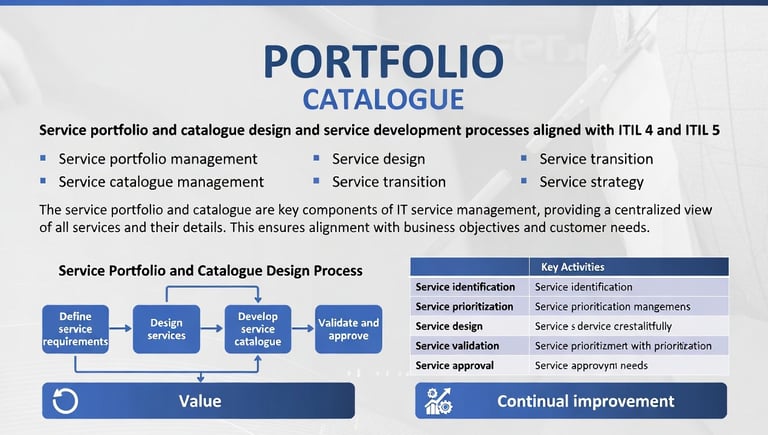
Designing a Service Portfolio Catalogue and Service Development Processes:
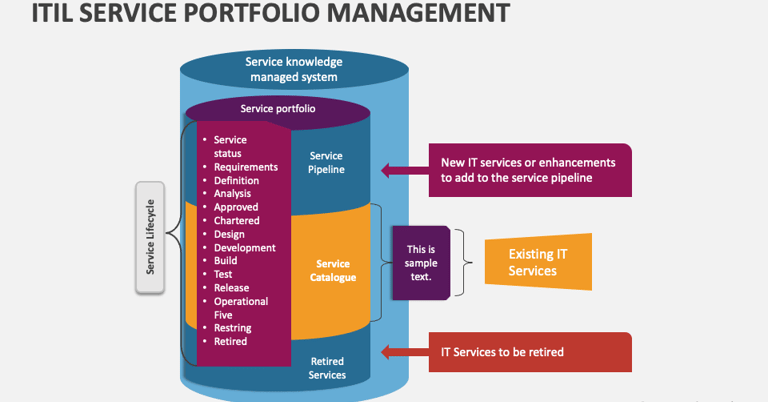
The backbone of any managed services practice is the ability to design, develop, implement and manage solutions for different customers using a range of technologies. When designing a process for service portfolio management and service development, frameworks like ITIL provide essential guidance for organisations to deliver value through efficient, user-centric services, and ISO20000 can be used to provide formal recognition ad assurance to your customers.
ITIL 4 shifted focus from rigid processes to flexible practices and a Service Value System (SVS) emphasizing co-creation of value.
ITIL Version 5 (often called ITIL 5) has arrived as an evolutionary update, shifting to "Digital Product and Service Management," treating products and services as interconnected entities to eliminate silos between development and operations. This unified approach incorporates AI governance, sustainability, and user experience (UX) as core elements.
ISO20000 is a certifiable international standard for a service management system.
ITIL accreditations are achieved by the individual, and these skills will be expected in a well-managed service management team. ISO20000 provides recognition that the recommendations in these standards have been implemented by the MSP.
Best Practices for Service Portfolio Catalogue Design:
Designing an effective catalogue requires a structured approach to ensure it’s user-friendly, accurate, and aligned with business needs.
Identify and Scope Services/Products: Start by mapping all current, planned, and retired offerings. Focus on services fitting the business strategy and market analysis; include digital products and AI-enabled features for leading edge capabilities.
Categorise and Organize: Group entries by function or type, which will be a combination of professional and managed services. Analyse these as a portfolio even if they are delivered by different parts of the organisation, such as the professional services or application development. ITIL 5 emphasizes UX design, making catalogues intuitive with AI-driven search and personalization.
An example catalogue would include:
Assessment and preparation – customer education, workshops, application and infrastructure discovery
Migrate and Modernise – Creation of new environment, migration, modernisation of workloads and new security models
Service Management – Ssrvice desk, customer success, management platforms, application insights
Optimisation – workload location rightsizing, application modernisation, automation
Secure – End point protection infrastructure protection, workload protection, mitigate detect, recover
Integrate with Tools and Automation: Leverage ITSM platforms that enable dynamic catalogues. Ensure integration with CMDBs for accuracy. Embed AI for predictive analytics, such as recommending services based on user behaviour.
Maintain and Review: Regularly update for changes, using continual improvement. ITIL 5 adds sustainability metrics, like carbon impact assessments for services.
Service Development Processes
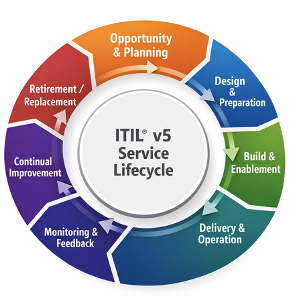
ITIL 5 replaces the SVC with an eight-activity Product and Service Lifecycle for greater flexibility in AI-enabled, product-focused environments: Discover, Design, Acquire, Build, Transition, Operate, Deliver, and Support. This supports continuous experimentation, with "stepping stones" for non-linear progression, embedding AI for automation and human-centric design.
The ITIL 5 lifecycle diagram highlights stages like Opportunity Planning and Continual Improvement, aligning development with measurable outcomes and resilience.
Both ITIL versions integrate with Agile, DevOps, and Lean, but ITIL 5 prioritizes AI-native processes, such as using AI for discovery (e.g., predictive demand analysis) and sustainability in design.
Aligning your service development process with this model will help to ensure that nothing is missed. The CCoE should be responsible for collecting ideas for new or improved services, from the customer base, industry trends and the internal team. Gates should be built into the process with clearly defined requirements to move forward, collateral to be created at each stage and knowledge transfer to sales and support, as well as a market launch strategy. These can be summarised as:
Strategy and portfolio alignment: verifying the business case, ROI and vision for the service
Building the service: Defining service parameters, business and technical requirements
Detailed design and architecture: Technical low level design, service dependencies, operational design
Delivery and operations: Systems integration, automation development, knowledge transfer, change management
Monitoring and feedback: Functional testing, performance and security testing, service validation, user acceptance testing and operational readiness
Production deployment: go to market activities, hypercare support, continuous improvement feedback
Ongoing operations: ITIL standard processes
Continual improvement and service evolution: evolve, enhance, retire the service based on market response and changing trends
Conclusion:
Aligning your service portfolio catalogue design and development processes with ITIL 4 and 5 will enable the MSP to adapt to digital transformation while focusing on value, sustainability, and user needs.
Taking these steps will help to ensure that you have control of your service development and portfolio management processes. Evaluate your current capability against these best practices and identify 2-3 key actions to take to improve, then iterate once these are achieved. If you need further help please get in contact.